When is land more valuable — when it hosts a datacentre or a farm?
Excerpt from 'Data center land use issues are fake', by Andy Masley, May 2, 2026:
And then, in the middle of all this, a farmer in Loudoun County sells a few acres of mediocre hay field to a hyperscaler for ten times its agricultural value, and the response is that we’re running out of farmland.
The marginal Virginia hay field is worth more as a data center than as hay. The marginal Iowa cornfield going to ethanol would be much better if it were nothing at all. When a farmer in Loudoun County wants to sell to Amazon for ten times the land’s agricultural value, the correct response is to wish them well. We need way less farmland than we currently use, and it’s fine if data centers buy some.
I did some reading and it seems Masley's argument is current in the US context. Farmers there have indeed been producing from less land for a while now. Since the 1930s, the corn yield has increased more than sevenfold. So Masley's conclusion that converting arable land to land for datacentres is desirable seems reasonable.
But his post got me thinking about the situation in India — and here it seems his argument would fail (not that he's expressed any interest in this part of the world).
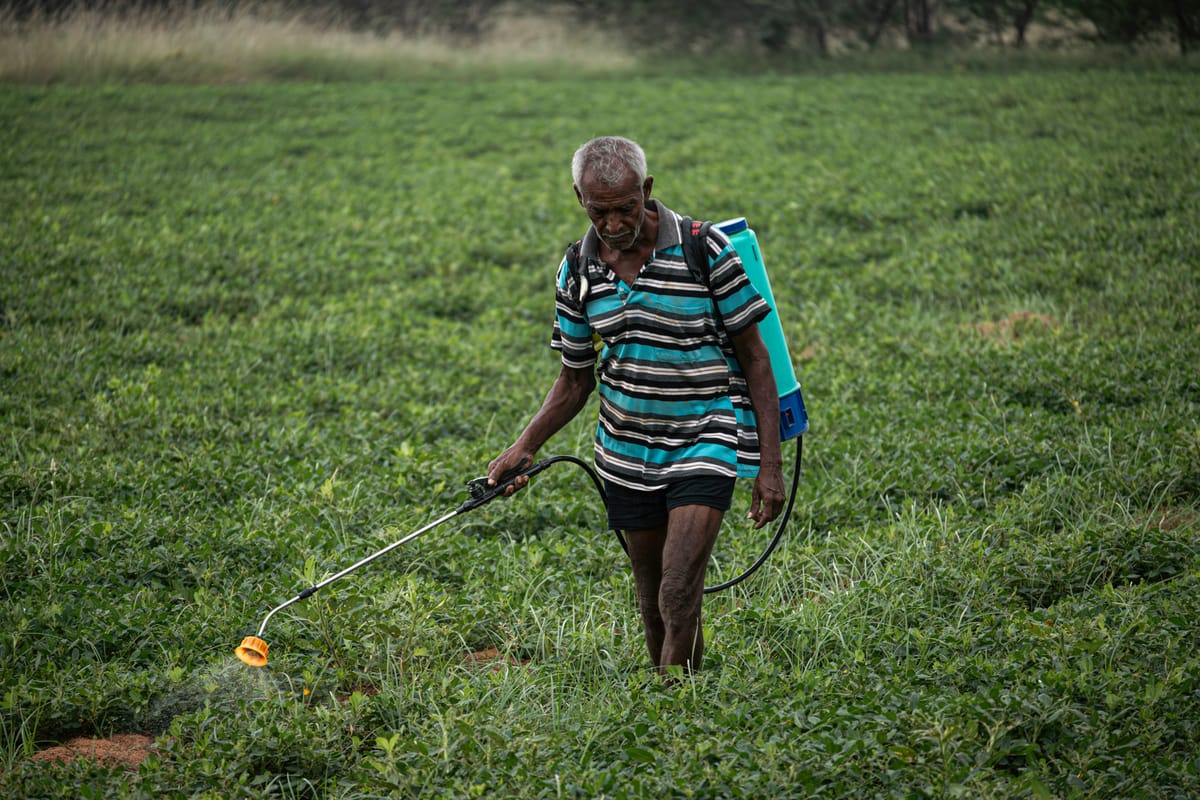
Higher yield isn't the same as higher productivity on the same, capable parcel of land. This is because agricultural researchers and farmers can increase the yield using better agronomy, hybrid breeding, precision planting, and so on. That said, farmers in India and in many places around the world, including in the US, have been more engaged in rendering the land more productive by intensifying the external inputs. For example, US agricutural use of nitrogen fertilisers has increased roughly seven- to tenfold since the 1940s. Together with the expansion of irrigation volume, mass and composition of pesticides applied, and the degree of mechanisation, the land certainly wouldn't be as productive as it is today.
Both the UN Food and Agriculture Organisation and the US Department of Agriculure's Land Capability Classification distinguish between land with good natural agricultural potential and land whose productivity depends more heavily on inputs and management. Soil scientists draw a similar line, for similar reasons, between inherent soil fertility — which is the natural endowment of nutrients, capacity to hold water, and biological activity — and effective soil fertility, which is the productivity achieved by escalating the application of inputs. Agricultural economists also keep track of a figure called total factor productivity (TFP): if the yield in a specific hectare rises mainly because farmers are applying disproportionately more water or fertilisers, say, the gains in TFP may stagnate or even decline.
Against this background, let's call Masley's category of lands that stay productive without increasing inputs 'inherently capable land' and land rendered productive by applying more and more inputs 'input-dependent land'.
Most of the increase in agricultural productivity in India since the Green Revolution has happened on input-dependent land. The Revolution's heartland in North India, especially Punjab and Haryana, has since been notorious for its fertiliser use and groundwater extraction, supported by state subsidies. Increases in the region's yield gains have also been flat for two decades or so now — and it's possible maintaining just the current yield level in many areas requires more and more inputs.
So the claim that "we need way less farmland than we currently use" works only if the land's fertility is almost entirely he also assumed the land's inherent fertility, i.e. that it is inherently capable land. And if the country has already identified and priced that land accordingly, and where production is in surplus relative to domestic demand — so that a temporary drop in the arable area doesn't threaten access to food. And very rarely do any of these conditions operate simultaneously in any agricultural market in India. The country has around 180 million ha of net sown area for 1.4 billion people (excluding exports). In 2023, according to the World Bank, there was 0.107 ha of arable land per capita, steadily down from 0.359 ha per capita in 1961. Equally, many productive farms in India today are most likely on input-dependent land, and that too only because state governments also subsidise electricity for pump sets and fertiliser costs. The national fertiliser subsidy in 2023-2024 was Rs 1.8 lakh crore, up from Rs 65,971.5 crore in 2013-2014.
In fact, even converting a parcel of land that has become functionally 'dead' following input-heavy cultivation for datacentre use is a bad idea for four reasons: it creates a perverse incentive for landowners to allow the land to degrade; the location will require additional infrastructure, like roads and power transmission equipment, the cost of which has to be added to the overall cost of conversion; 'dead' land is difficult to define as a category for administration (more so in a country that has historically used "wasteland" and similar categories of land to acquire ownership of common areas over which local communities have claims); and 'dead' land can still recover its ecological value over time.
So it is not possible to say whether it is okay to acquire arable land in India for use as a datacentre after checking only the current yield. At the least, we must also check the conditions in which the land is productive.
Second, throughout his post, in order to determine whether X parcel of land could be more valuable as a datacentre or as a farm, Masley has considered land parcels to be independent units. So let's consider a hypothetical scenario to bring this assumption into the real world (somewhat). Say there is a 4x4 grid of 16 parcels, and the first quadrant of four parcels has been converted for a datacentre's use. What will that do to the remaining 12 parcels?
A datacentre drawing from a common subterranean aquifer will create a cone of depression — a conical dip in the local water table that also reduces the water pressure. According to the Central Pollution Control Board, over-exploited aquifer zones cover around 14% of India's groundwater blocks. In these places, any additional large consumer will push the rate of groundwater extraction closer to or even past the safe yield limit, which is the point beyond which extracting groundwater will have undesirable effects on the surrounding land. The upcoming datacentre corridor in Hyderabad is expanding into just such an area. In this place, the 12 remaining arable parcels are likely to have their yields as well as water table drop and for the marginal water cost to rise.
Next, all datacentres have a high and fixed minimum power demand, which means the windows in which states currently supply (rationed) electricity could narrow further, and the voltage could also drop. Third, datacentres expel heat of roughly the same magnitude as the electricity they consume. In the semi-arid areas that dominate peninsular India, including Andhra Pradesh, Telangana, and parts of Karnataka, plumes of heat from datacentres can further raise the local ambient temperature, disrupting crops' evapotranspiration and local heat stress limits. Note here that the thermal and microclimate effects vis-à-vis agricultural performance are understudied in India. In fact when Masley discussed the example of Morrow County in Oregon, he dismissed the Amazon datacentre's water demand as only 0.4% of the local irrigation demand. But the more important question is whether the new water demand will push the water table beyond the safe yield threshold. (FWIW, Morrow County had declared an emergency in 2022 over nitrate levels in drinking water drawn from the groundwater.)
Taken together, Masley's arguments yield sensible conclusions when they come with surplus land and independent land parcels but insensible ones otherwise. And in India, the conditions are mostly otherwise.
Featured image credit: Naren Marthandan/Unsplash.
![A close-up photograph of yellow crime scene tape in sharp focus reading "CRIME SCENE DO NO[T CROSS]", with a group of blurred](/content/images/size/w600/2026/06/joshua-coleman-g86cbfibd6e-unsplash.jpg)